
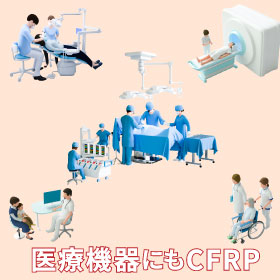
Features and examples of CFRP that achieve lightweight and high precision in medical devices.
Introducing the reasons for using CFRP (Carbon Fiber Reinforced Plastic) in medical devices, along with its advantages and characteristics through examples.
In the medical device industry, there is a demand for reducing the burden on patients and healthcare professionals, improving operability, and achieving precise movements. Generally known as carbon, CFRP (carbon fiber reinforced plastic) is increasingly being adopted in the medical device industry due to its various characteristics. Here, we introduce the representative features of CFRP and specific examples of its adoption. - It is lightweight, with a specific gravity of 1/4 that of iron and 2/3 that of aluminum. - By arranging the fibers, it is possible to achieve rigidity in the required direction that exceeds that of metals. - It has excellent vibration damping properties, allowing vibrations to settle quickly. - It has superior X-ray permeability. - Its thermal expansion is extremely low, at 1/5 to 1/10 that of metals, providing excellent dimensional stability and minimal degradation of functional properties even at high temperatures. By designing materials and laminates according to the intended use, it is possible to manufacture medical device components that maximize these advantages.
- Company:TIP composite Co., Ltd.
- Price:Other


![[OEM Contract Available] Contract Processing of Medical Device Parts at Our Own Factory](https://image.mono.ipros.com/public/product/image/97a/2000348502/IPROS57276453366846985647.jpeg?w=280&h=280)
![[Production Example] Inspection Device Parts <Hastelloy>](https://image.mono.ipros.com/public/product/image/fa7/2000908565/IPROS37170277502481645857.jpeg?w=280&h=280)


![[Sheet Metal Processing Example] Medical Device Parts](https://image.mono.ipros.com/public/product/image/a30/2001216687/IPROS09151510170082692381.png?w=280&h=280)
![[Product Example] Medical-related Parts <SUS631CSP-3/4H>](https://image.mono.ipros.com/public/product/image/b3d/2001134216/IPROS20512408804574496129.jpeg?w=280&h=280)
![[Example] Deep hole machining of small diameter stainless steel material](https://image.mono.ipros.com/public/product/image/4ee/2000664580/IPROS26422618035134851486.jpeg?w=280&h=280)
![[Grinding Achievements] Medical Device Parts](https://image.mono.ipros.com/public/product/image/557/2001172125/IPROS89695313117877159372.png?w=280&h=280)
![[Processing Example] Medical Device Parts](https://image.mono.ipros.com/public/product/image/387/2000965018/IPROS78073463302639834462.jpeg?w=280&h=280)
![Introduction of research and development products [Anodizing treatment]](https://image.mono.ipros.com/public/product/image/2c9/2001222215/IPROS91361175496529601074.png?w=280&h=280)





![[Production Example] Ophthalmic Measurement Equipment Parts <102.9×48×t45>](https://image.mono.ipros.com/public/product/image/20e/2000908560/IPROS26340454082058203597.jpeg?w=280&h=280)
![[Production Example] Inspection Device Parts <A5052>](https://image.mono.ipros.com/public/product/image/fd9/2000908562/IPROS61221436226162184352.jpeg?w=280&h=280)


